Successful post-operative outcome after percutaneous endoscopic cervical discectomy
2022.6 Successful post-operative outcome after percutaneous endoscopic cervical discectomy
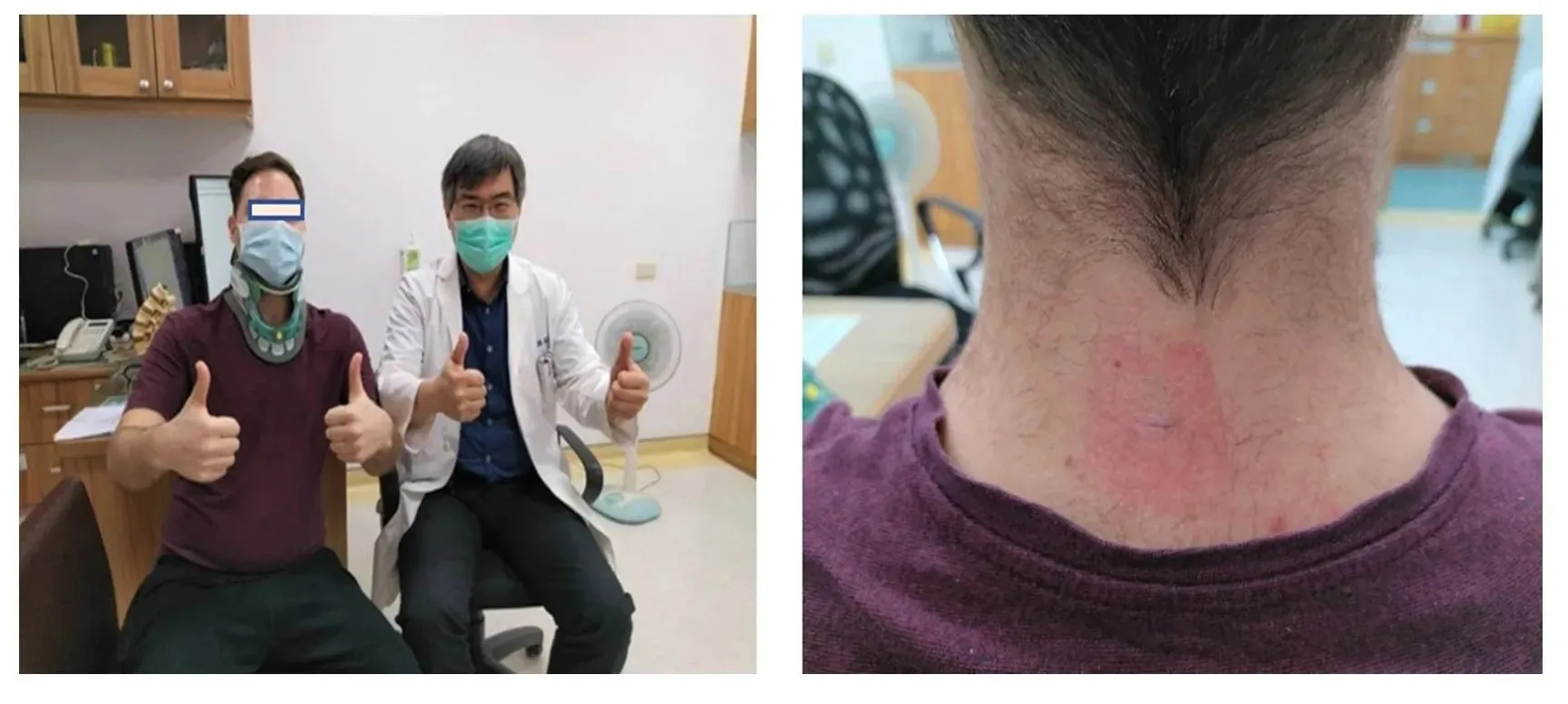
DAVIN, a South African national, was deeply impressed by Taiwan's outstanding epidemic prevention measures during the severe COVID-19 pandemic. He believed that Taiwan provided better safety guarantees in terms of epidemic control and living and working environments compared to other countries. After careful consideration, DAVIN decided to come to Taiwan to develop and avoid the epidemic. Both he and his girlfriend started working at a bilingual private school in Taichung.
While in Taiwan, DAVIN experienced discomfort in his shoulders, neck, and upper limbs after a fall accident. He exhibited clinical symptoms of nerve compression in the cervical spine. In March 2021, he brought a magnetic resonance imaging (MRI) disc from another medical center to the outpatient clinic of the Department of Neurosurgery at our hospital, where Dr. Tsou His-Kai provided him with a consultation. Despite the late hour, Dr. Tsou patiently examined and treated DAVIN. With the assistance of physical examination, X-ray imaging, and the MRI performed at the external institution, Dr. Tsou diagnosed him with a protrusion of the intervertebral disc at the fourth and fifth cervical vertebrae, which caused shoulder, neck, and left upper limb pain and discomfort. Dr. Tsou suggested that DAVIN undergo a minimally invasive endoscopic surgery of the cervical spine to partially remove the affected disc and relieve the compression on the spinal nerves.
Cervical spine endoscopic surgery is a highly demanding and precise minimally invasive procedure, and our hospital is a leading institution in its development in the central region of Taiwan. The surgery is characterized by minimal tissue damage, a short hospital stay of only two days, the ability to walk and take care of personal hygiene on the same day as the surgery, the need to wear a neck collar for only one month, and the ability to engage in light daily activities or desk work during the recovery period. Patients can take care of themselves without requiring assistance from others, resulting in minimal impact on their daily lives and the lives of their family members.
The follow-up schedule for cervical spine endoscopic surgery includes visits at two weeks post-surgery and subsequent follow-ups every three months up to one year, during which X-ray and MRI examinations are performed to compare with the pre-surgical images and confirm the satisfactory recovery process. Once the complete treatment is confirmed, the patient's medical journey is considered complete. After completing the full course of treatment, DAVIN and his girlfriend returned to their home country in June 2022 to visit their families and pursue career development due to being away from home for an extended period and considering the subsequent development of the epidemic in Taiwan.
Cervical spine endoscopic surgery is one of the highlights of our hospital's medical services. It is a blessing for patients with simple intervertebral disc protrusion in the cervical spine, no significant instability of the cervical vertebrae, and no calcification of the posterior longitudinal ligament. Through the personal experience and sharing of our international friend, we can further showcase Taiwan's strong medical capabilities and contribute a touching story to international healthcare.