Collaborating with Tech Giants NVIDIA and Foxconn: Taichung Veterans General Hospital is Helping to Build Smart Healthcare
Collaborating with Tech Giants NVIDIA and Foxconn: Taichung Veterans General Hospital is Helping to Build Smart Healthcare
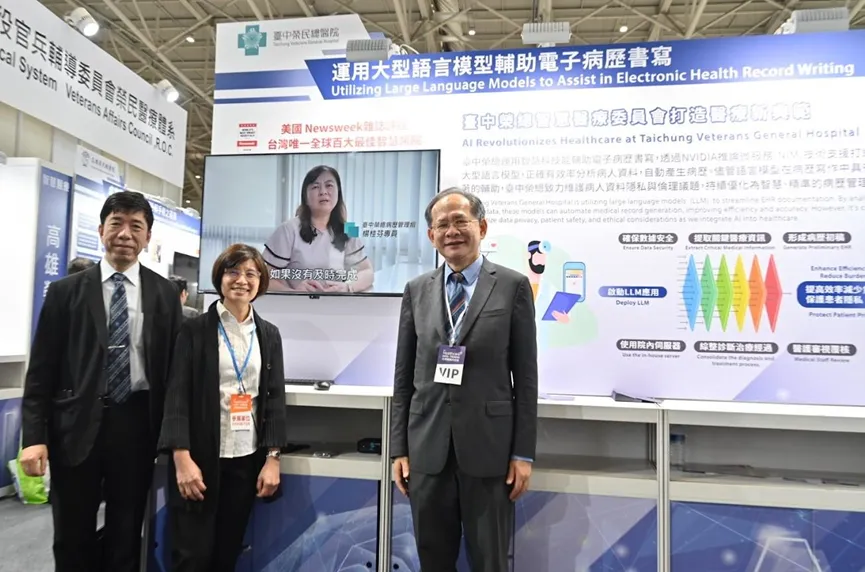
Taichung Veterans General Hospital Partners with NVIDIA to Implement the H200 Supercomputer for Accelerating AI-Assisted Electronic Medical Record Documentation. From right to left Taichung Veterans General Hospital Superintendent Shih-Ann Chen, Department of Medical Administration Deputy Director Kai-Li Liang, and Smart Healthcare Committee Executive Director Kun-Hui Chen
Taichung Veterans General Hospital (TCVGH), the only Taiwanese hospital to enter Newsweek's global Top 100 Smart Hospitals, has made significant strides in recent years by implementing the H200 supercomputer to accelerate AI development. Through collaborations with NVIDIA and Foxconn, our hospital has been able to achieve effective integration of artificial intelligence into healthcare, with remarkable results. At the 2024 Taiwan Healthcare Expo, TCVGH’s theme, "Merging Healthcare and Technology: From Taiwan to the World," highlighted its advancements in smart healthcare, cutting-edge medicine, precision medicine, regenerative medicine, and telemedicine.
We have partnered with NVIDIA to introduce "automatic speech recognition for medical consultation hotlines" and "large language model-assisted electronic medical record (EMR) documentation." These initiatives have reduced the administrative burden on medical staff and streamlined operations.
In collaboration with Foxconn, TCVGH has developed innovative applications of digital twins and AI in breast cancer treatment, such as rapid and precise kidney ultrasound diagnostics and an app for detecting occupational musculoskeletal injuries.
Taichung Veterans General Hospital's 24/7 medical consultation hotline receives approximately 2,000 calls monthly. Previously, nurses manually entered consultation details into the system and wrote follow-up notes, a time-consuming and incomplete process. [Is it ok to omit “based on memory”? It implies that the nurses didn’t take notes during the call and just relied on their memory of the call. The nurses probably did take notes, but explaining all of that here seems unnecessary. The point of this sentence is to say that the new system is better. So, my suggestion is to cut these three words.]
To address this, the hospital collaborated with NVIDIA to develop an Automatic Speech Recognition (ASR) system that uses speaker segmentation, sequence reconstruction, and medical terminology recognition. Enhanced by Large Language Model (LLM) capabilities, the system converts voice data into structured text and produces polished "consultation summaries." It distinguishes between nurse and patient dialogues, reducing documentation time per call by 3–5 minutes and improving service quality.
According to Liu Shu-Fang, Deputy Director of Nursing, this system could be extended to applications such as clinical nursing records and shift handovers, alleviating the documentation burden and allowing nurses to focus on patient care.
Through close collaboration with Foxconn, Taichung Veterans General Hospital ,has co-developed a Digital Twin model for breast cancer treatment by leveraging NVIDIA’s high-performance computing platform Taipei-1. By integrating clinical data and imaging, the model creates 3D virtual breast models to predict personalized treatment outcomes, prognosis, and potential side effects, which involves the us of AI's to conduct multimodal and multivariate analysis.
The hospital has also introduced an Occupational Musculoskeletal Injury Detection App, an innovative global first. By combining AI with the Key Indicator Method (KIM) scale, the app performs risk assessments for cumulative musculoskeletal stress. Visitors at the expo could experience the app firsthand by demonstrating repetitive movements from daily life or work. The app instantly analyzed their posture, assessed risk, and used 3D imaging to visualize skeletal load. These data aid healthcare providers in designing personalized rehabilitation plans.
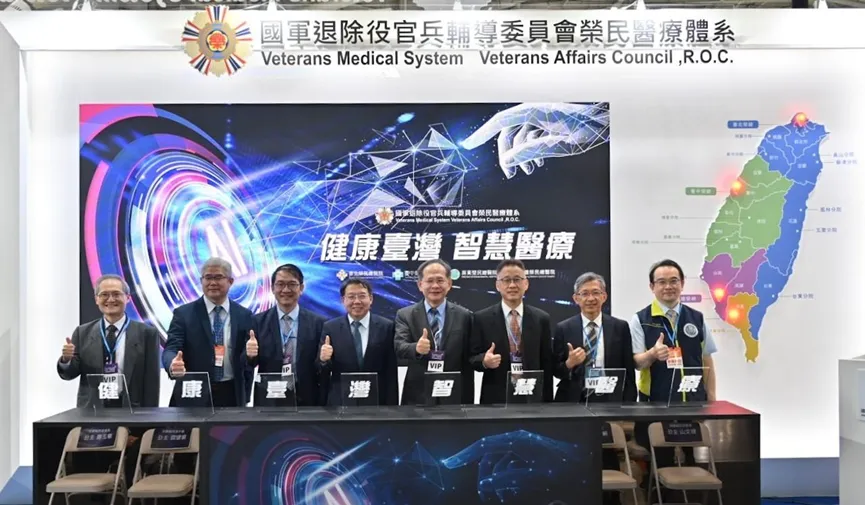
Taichung Veterans General Hospital Superintendent Shih-Ann Chen (fourth from the right) attended the opening ceremony of the Veterans Healthcare System at the 2024 Taiwan Healthcare Expo.
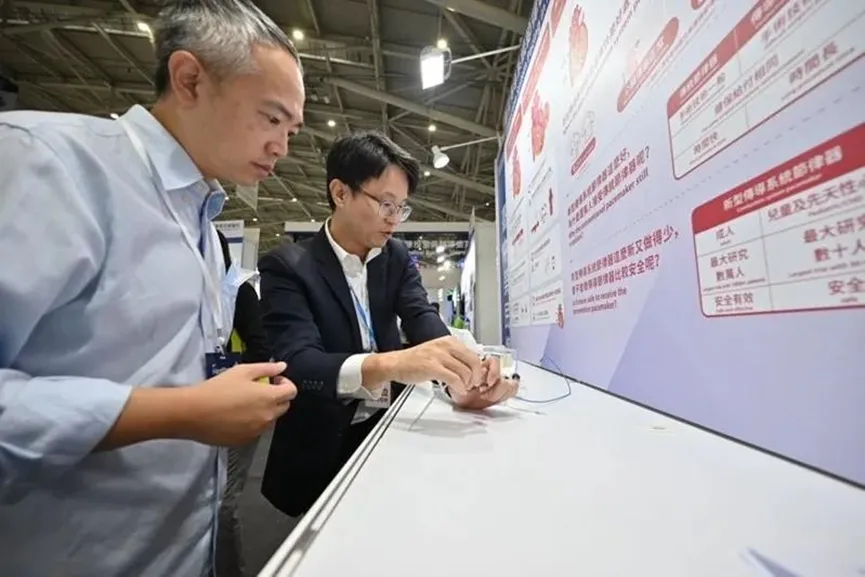
Dr. Chieh-Mao Chuang (right) from the Pediatric Cardiology Department of Taichung Veterans General Hospital explains to the public how the new conduction system pacemaker treats atrioventricular block.
Source materials:https://udn.com/news/story/7266/8406377